

One of the most difficult sounds for many learners of English to reproduce is the ‘th’ sound.
Did you know that ‘th’ has two sounds? Look at the words at the table below:
θ |
ð |
| think | then |
| thought | this |
| three | the |
| both | than |
Listen to the audio to hear the pronunciation:
The two different sounds are the unvoiced ‘th’ (θ) and the voiced ‘th’ (ð).
Both sounds are created by putting the tongue between the teeth at the start, but the next part is different:
- The unvoiced ‘th’ does not vibrate the throat. The sound is made by air escaping past the tongue and teeth when the tongue is released.
- The voiced ‘th’ does not need the air escaping to make the sound, but instead there is a vibration in the throat.
Look at the two illustrations below:
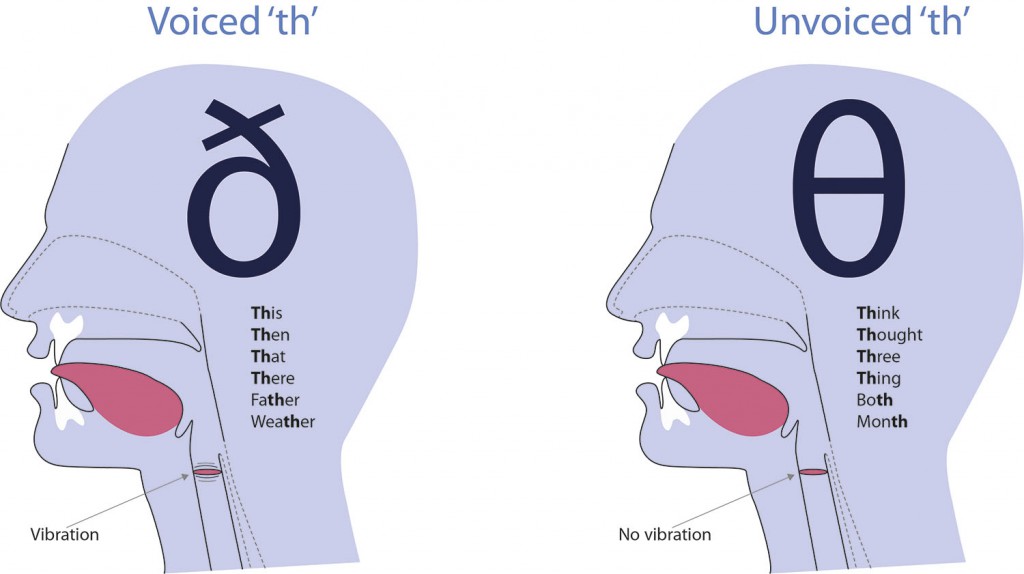
The voiced ‘th’ (ð)
So the voiced ‘th’ starts with the tongue between the teeth then releases it and a vibration in the throat creates the sound.
Examples:
| This | Then | That |
| There | Father | Weather |
Look at the video below (in MP4 format if your browser supports it):
| Voiced 'th' examples | ||
|---|---|---|
| Word | Phonetic Spelling | Audio |
this |
ðɪs |
|
then |
ðen |
|
that |
ðæt |
|
there |
ðeər |
|
father |
ˈfɑː.ðər |
|
weather |
ˈweð.ər |
|
The unvoiced ‘th’ (θ)
So the unvoiced ‘th’ starts with the tongue between the teeth then releases it and the air escaping creates the sound.
Examples:
| Think | Thought | Three |
| Thing | Both | Month |
Look at the video below (in MP4 format if your browser supports it):
| Word | Phonetic Spelling | Audio |
|---|---|---|
think |
θɪŋk |
|
thought |
θɔːt |
|
three |
θriː |
|
thing |
θɪŋ |
|
both |
bəʊθ |
|
month |
mʌnθ |